- Pondok Pesantren Putri IMMIM Pangkep, Pesantren yang khusus menerima santri putri ini, kampusnya berada di bilangan jalan poros Kecamatan Minasatene Kabupaten Pangkep

Menyelesaikan 6 Free Courses “History & the Arts” OpenLearn the Open University
Oleh: Muhammad Farid Wajdi *)
Related Post: Mengikuti Free Online Course, “Herodotus and The Invention of History” di OpenLearn The Open University
BLOGGURU – Alhamdulillah, satu kesyukuran dan kebahagiaan tersendiri dapat mereguk nikmatnya menuntut ilmu dan pembelajaran tanpa batas. Semuanya ini dapat terwujud atas berkah waktu luang, kesempatan, dan kesehatan yang baik. Dalam dua hari terakhir ini, Kamis-Jumat (11-12/9/2025), saat berada di Hotspot Center dalam Lingkungan Ponpes Modern Putri IMMIM Minasatene-Pangkep, disela-sela kegiatan Ngeblog, penulis menyempatkan mengikuti 6 Free Courses “History & the Arts” di situs OpenLearn, the Open University yang berpusat di Inggris, dengan kampus utama di Milton Keynes, Buckinghamshire, Inggris (United Kingdom).
Keenam Kursus pada Menu “History & the Arts” OpenLearn The Open University ini sudah lama penulis akrabi materi dan sebenarnya merupakan pengulangan (muraja’ah materi) pembelajaran sejarah dan budaya. Kesemua Kursus yang penulis ikuti ini bersifat Free (gratis) di situs OpenLearn, termasuk sertifikat tanda penyelesaian kursus yang disebut “Statement of Participation”.
Keenam Kursus yang penulis selesaikan dalam dua hari terakhir ini, Kamis-Jumat (11-12/9/2025) adalah sebagai berikut (lengkap dengan deskripsi kursusnya dalam Bahasa Inggris):
Course Description
The ancient Greeks did not have a term equivalent to the English word ‘religion’. However, their world was populated by numerous figures they both recognised and worshipped as divinities. Among these figures was Amphiaraos, an ancient Greek hero who was later worshipped as a god and popularly associated with healing through the medium of dreams. But there was no sacred book (like those which exist in many religions today) which told the ancient Greeks what to believe about Amphiaraos or how to communicate with him. How, then, did people and communities know how to worship Amphiaraos?
In this course, you will explore this question by looking at textual and visual evidence relating to Amphiaraos’ sanctuary, which was located at a town called Oropos, in northeast Attica. You will engage with this material to learn about some of the different ways the ancient Greeks interacted with Amphiaraos, both individually and as part of their community.
Interested in taking your learning further? You might find it helpful to explore the Open University’s Classical Studies courses and qualifications.
Course Learning Outcomes
After studying this course, you should be able to:
- develop awareness of the rich and complex relationship between politics and religion in the ancient Greek world
- understand how to uncover personal experiences in the study of ancient religions
- feel confident in working with both ancient texts and visual source material to answer questions about ancient Greek religion
- use Amphiaraos’ sanctuary as a case-study for understanding the broader political and personal aspects of ancient Greek religion.
Course Description
This free course focuses on Rome’s first emperor, Augustus, who lived from 63 BCE to 14 CE. The rule of Augustus marked a significant political change in Rome, and Augustus’ position as emperor was initially fragile and controversial. Key to his success in holding onto power was his masterful use of visual propaganda to cement his position and underline his legitimacy. The course examines the various roles Augustus constructed in an attempt to appeal to as many people as possible, and highlights the central importance of dress in Augustus’ imagery. To illustrate this, the course will also look at Abdullah II, who became king of Jordan in 1999, who applies a similar principle to his portraiture.
Interested in taking your learning further? You might find it helpful to explore the Open University’s Classical Studies courses and qualifications.
Course Learning Outcomes:
After studying this course, you should be able to:
- understand how political leaders can construct various different roles to appeal to as many people as possible
- understand the key role that visual representation and dress plays in these roles
- show some knowledge of the personality and history of Rome’s first emperor Augustus, and some of the ways in which he consolidated his power
- analyse images and source texts, and compare them to one another.
Course Description
This free course introduces Homer’s ancient Greek epic poem, the Odyssey, which tells of Odysseus’ long journey home after fighting in the Trojan War, and his eventual reunion with his wife Penelope. Odysseus is famous for his cunning and his courage, and for the exploits he undertakes on his travels; meanwhile Penelope is renowned for her patience and faithfulness as she awaits his return. Meet Penelope and Odysseus and learn more about what it means to be a hero in their world as well as in our own.
Interested in taking your learning further? You might find it helpful to explore the Open University’s Classical Studies courses and qualifications.
Course learning outcomes
After studying this course, you should be able to:
- understand the plot and structure of the Odyssey
- identify some of the ways in which Homer constructs the characters of Penelope and Odysseus
- read in detail short passages of text and analyse the effects of the poetic techniques used
- discuss some key themes of the Odyssey including: homecoming; disguise and recognition; gender roles; and the representation of the figure of the hero.
Course Description
What do historians do? In this free course you will explore some of the ways that historians work to develop our understanding of the past. You will learn about three aspects of the historian’s craft through three topic areas: landscapes, infant health and criminal justice. Through the activities in the course, you will experience a wide range of historical evidence and understand its importance for historians in constructing new knowledge.
This OpenLearn course is an example of postgraduate-level study and gives some insight into the study of history you might undertake if you were to study the MA in History (A883/4).
Course Learning Outcomes
After studying this course, you should be able to:
- appreciate how historians develop research ideas from different starting points
- understand some of the choices and processes involved in researching the past
- have a critical awareness of the wide range of sources historians use for evidence, beyond the textual to include visual, material and physical
- recognise that historians work within longstanding traditions of learning and knowledge construction.
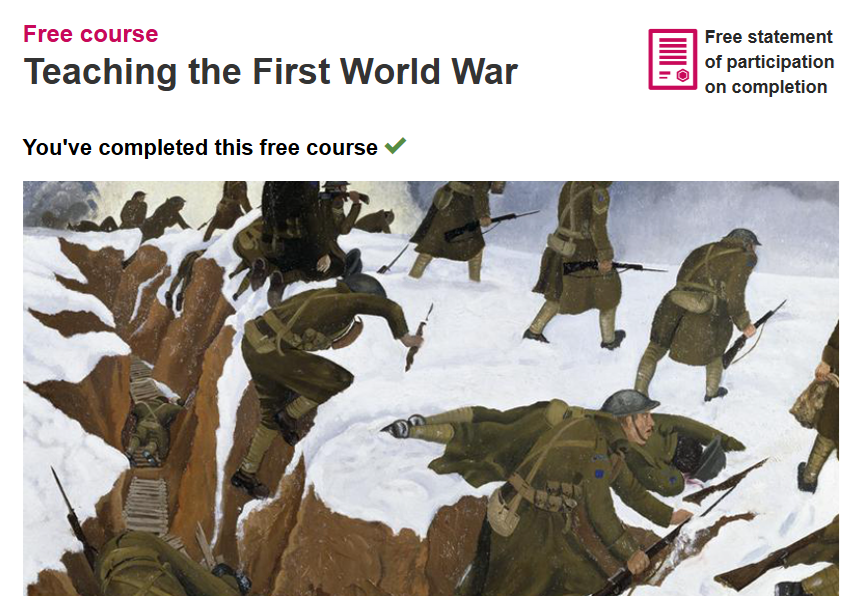
It includes skills development for teachers and their pupils, including document analysis, advanced techniques in internet searches for primary and secondary sources, and how to evaluate and identify the most suitable literature on the topic.
Course learning outcomes
After studying this course, you should be able to:
- understand topics relating to the history of the First World War, including its origins, the role of propaganda, the experiences and memories of non-European combatants, and aspects of commemoration and memory
- analyse primary sources, including documents, paintings and objects, and develop ideas for how these sources can by analysed by students in the classroom
- use advanced search techniques for locating primary and secondary sources on different online platforms
- evaluate search results to identify the most suitable literature for your own work and your students
- explain search techniques which will be helpful for students’ non-exam assessment (NEA) projects.
Course Description:
In the eighteenth century and into the early part of the nineteenth, considerable numbers of aristocratic men (and occasionally women) travelled across Europe in pursuit of education, social advancement and entertainment, on what was known as the Grand Tour. A central objective was to gain exposure to the cultures of classical antiquity, particularly in Italy. In this free course, you’ll explore some of the different kinds of cultural encounters that fed into the Grand Tour, and will explore the role that they play in our study of Art History, English Literature, Creative Writing and Classical Studies today.
This OpenLearn course is an adapted extract from the Open University course A112 Cultures.
Course learning outcomes
After studying this course, you should be able to:
- understand some of the key characteristics of the Grand Tour as a cultural practice in eighteenth and nineteenth century Europe
- appreciate why the ancient world was so significant for modern visitors of this era
- analyse a range of different texts and images, both ancient and modern
- reflect how how these texts and images can prompt new creative activity, and put this into practice.
Demikian sedikit catatan dari penulis sebagai pengingat kegiatan yang telah diikuti. Insya Allah, pada kesempatan lain, penulis akan mengulas konten daripada keenam Free Courses “History & the Arts” OpenLearn the Open University tersebut diatas. Semoga bermanfaat adanya. Barakallahu fiikum. (*)
Prestasi Lainnya