Oleh: Muhammad Farid Wajdi *)
BLOGGURU – Alhamdulillah, satu kesyukuran dan kebahagiaan tersendiri dapat mereguk nikmatnya menuntut ilmu dan pembelajaran tanpa batas. Semuanya ini dapat terwujud atas berkah waktu luang, kesempatan, dan kesehatan yang baik. Kemarin, Senin (25/8/2025), penulis mengikuti 3 kursus “Getting Started With French” (1-2-3) di situs OpenLearn, the Open University yang berpusat di Inggris, dengan kampus utama di Milton Keynes, Buckinghamshire, Inggris (United Kingdom).
The Open University ini sudah lama penulis akrabi pembelajaran jarak jauh yang ditawarkannya. Semua bersifat Free (gratis) di situs OpenLearn, termasuk sertifikat tanda penyelesaian kursus yang disebut “Statement of Participation”. Tiga Kursus yang penulis selesaikan kemarin, Senin (25/8/2025) adalah sebagai berikut (lengkap dengan deskripsi kursusnya dalam Bahasa Inggris):
Introductory level Languages course – Getting started with French 1
Whether you want to visit, work or live in a French-speaking environment, you will get more out of the experience if you can communicate effectively with people. In this short course you will begin to develop your reading and listening skills in French and learn to speak and write the language to communicate in everyday situations. You will acquire a knowledge of the basic structures of French along with key vocabulary to meet and greet people and to talk about yourself and others.
This OpenLearn course is an extract from the beginning of the Open Centre for Languages and Cultures short course, LGXF001 Beginners French 1: eh oui!After completing this free course, you may wish to register for the full course to continue your learning!
Course learning outcomes
After studying this course, you should be able to: (1) say hello, goodbye and some of the first phrases to use when meeting a French speaker, (2) give one’s name and nationality, (3) use greetings and partings in different settings, (4) recognise ‘u’ and ‘ou’ sounds and the basic rules of French pronunciation, and (5) distinguish between masculine and feminine forms, spot the differences between them when reading and listening, and pronounce each form correctly.
Introductory level Languages course – Getting started with French 2
This two-week course offers you the opportunity to discuss food, your likes and dislikes as well as to shop or order food. Little by little, you will improve your ability to make more sophisticated conversations and to understand more complex language in a variety of different scenarios. You will also find out facts about France and French habits.
This OpenLearn course is an extract from the beginning of the Open Centre for Languages and Cultures short course, LGXF002 Beginners French 2: bien sûr!After completing this free course, you may wish to register for the full course to continue your learning!
Course learning outcomes
After studying this course, you should be able to: (1) discuss food, likes and dislikes, and be able to shop for or order food, (2) understand more sophisticated conversations and complex language in a variety of different scenarios, (3) recognise facts about France and French habits, (4) express likes using j’aime, j’adore, je préfère with the articles le, la, l’, les, and (5) express dislikes.
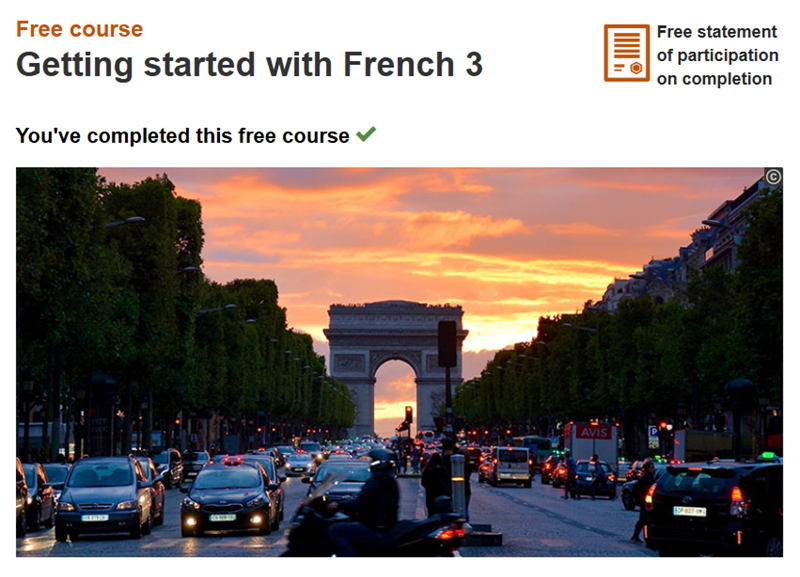
Introductory level Languages course – Getting started with French 3
In this course you will learn how to ask for directions in French. Along the way, you will build up your vocabulary so little by little you will be able to have more complex conversations and understand more French language in a variety of different scenarios.
This OpenLearn course is an extract from the beginning of the Open Centre for Languages and Cultures short course, LGXF003 Beginners French 3: absolument! After completing this free course, you may wish to register for the full course to continue your learning!
Course learning outcomes:
After studying this course, you should be able to: (1) ask for directions to key places in French-speaking towns, (2) use the main prepositions of location, (3) understand and give directions using a variety of phrases including devoir and il faut, (4) pronounce un, une and the letters ‘h’ and ‘r’, and (5) use vocabulary to indicate the sequence of events.
Demikian sedikit catatan dari penulis sebagai pengingat kegiatan yang telah diikuti. Insya Allah, pada kesempatan lain, penulis akan mengulas konten daripada ketiga kursus Getting Started With French (1-2-3) tersebut diatas. Semoga bermanfaat adanya. Barakallahu fiikum. (*)
Minasatene-Pangkep, 25 Agustus 2025
(* Muhammad Farid Wajdi, Guru/Pengasuh Ponpes Modern Putri IMMIM Minasatene-Pangkep, Sulsel.