We now live in a global village where distance is no longer a barrier to commercial or social contact. This free course, IT in everyday life, will enable you to gain an understanding of the information and communication technologies that drive our networked world and how they now permeate our everyday lives.
Course learning outcomes
After studying this course, you should be able to: (1) know the meaning of all the terms highlighted in the course, (2) understand the concept of the ‘network society’, and (3) have an awareness of how IT impacts on everyday life.
Download this Course: it_in_everyday_life_printable
Lihat disini: Statement of Participation: T175_2_statement
This free course explores Coulomb’s law, the physical law that governs the force between electric charges, and shows how it can be verified experimentally. As a prerequisite you will need some mathematical knowledge of vectors. This OpenLearn course is an adapted extract from the Open University course SM381 Electromagnetism.
Course learning outcomes
After studying this course, you should be able to: (1) describe the properties of Coulomb’s law and electrostatic force, (2) determine the force exerted on one stationary charge by another using Coulomb’s law, and (3) explain some of the uncertainties and errors that can occur in experimental measurements of electrostatic properties.
Download this Course: electromagnetism__testing_coulomb_s_law_printable
Lihat disini: Statement of Participation: SM381_1_statement
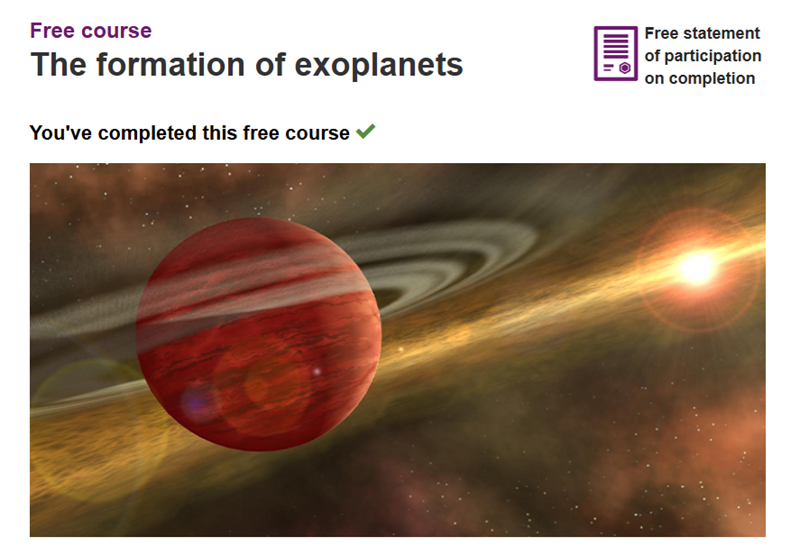
Over the last few decades astronomers have discovered thousands of planets orbiting stars other than the Sun – known as exoplanets. Many of these exoplanets are quite unlike anything we see in our Solar System. These include ‘hot Jupiters’ orbiting very close to their parent star and rocky ‘super Earths’ many times larger than our home planet. In this free course, The formation of exoplanets, you will learn about the challenges connected with efforts to reconcile the observed exoplanet population with current theories on how planets form. The two main theories for this, namely the core-accretion scenario and the disc-instability scenario, will be explored mathematically.
This OpenLearn course is an adapted extract from the Open University course S384 Astrophysics of stars and exoplanets. This content forms part of the Dangoor Education collection, the educational arm of The Exilarch’s Foundation.
After studying this course, you should be able to: (1) use mathematical models to calculate properties of protoplanetary discs, (2) understand the core-accretion scenario for the growth of planetary cores from smaller components, (3) understand the disc-instability scenario for the formation of planets from a circumstellar disc, (4) describe how planets migrate and interact after forming, (5) appreciate how planet formation models can explain the observed exoplanet population.
Download this Course: the_formation_of_exoplanets_printable
Lihat disini: Statement of Participation: S384_1_statement