By: Muhammad Farid Wajdi *)
Related Post: Mengenal Syaikh Abdurrahman bin Nashir As-Sa’di
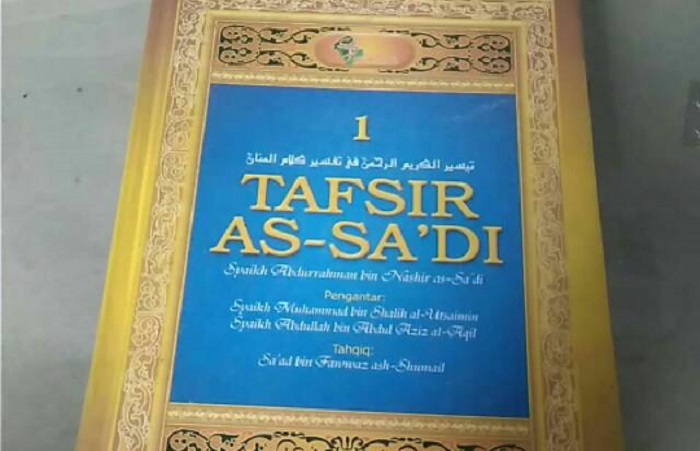
BLOGGURU – Here are some questions and answers related to the exegesis of Surah Al-Fatihah from Tafsir As-Sa’di.
1. Question (Q): You alone we worship and you alone we ask for help” combines between legislation and pre-decree (True or False?)?
Answer (A): True.
The statement “You alone we worship and You alone we ask for help” combines between legislation (worship as commanded by Allah) and pre-decree (reliance on Allah’s help, which He grants by His will and decree).
2. Q: Which of the following consists of that which no other part of the Quran consists of:
a. surah fatiha
b. ayatul-kursi
c. surah ikhlas?
A: Surah Al-Fatiha
Reason: (1) Surah Al-Fātiḥah is called “Umm al-Qur’an” (The Mother of the Qur’an) and “As-Sab’ al-Mathani” (The Seven Oft-Repeated Verses). (2) It uniquely contains a direct dialogue between the servant and Allah in the form of praise, worship, and request for guidance, unlike any other chapter. (3) The Prophet ﷺ said: “There has never been in the Torah, nor the Gospel, nor the Psalms, nor in the Qur’an anything like it.” (Hadith – Jami` at-Tirmidhi 2875)
Explanation of Others: (1) Ayatul-Kursi (Surah Al-Baqarah 2:255) – Greatest verse, but not a complete surah. (2) Surah Ikhlas (112) – Equates to one-third of the Qur’an in reward but does not contain what no other part has in essence.
Thus, Surah Al-Fatiha is the only one described in this way.
3. Q: The saying of Allah “king of the day of judgement” means that:
a. the reward will be just
b. the servant is the one does the deed and isn’t forced
c. the reward is for the actions committed by the person
d. all the above
Explanation:
The phrase “King of the Day of Judgement” (Mālik Yawm ad-Dīn) from Surah Al-Fātiḥah (1:4) implies:
- The reward will be just – Allah rules with perfect justice on that Day.
- The servant is the one who does the deed and isn’t forced – human actions are based on free will (within Allah’s decree).
- The reward is for the actions committed by the person – each individual will be recompensed according to what they earned.
Hence, it encompasses all three meanings.
4. The preposition and the noun following bismillah are linked to a verb which comes after it and has not been mentioned (true or false?)
A: True.
In the phrase “Bismillah” (بِسْمِ اللَّهِ), the preposition “bi” (with/in/by) and the noun “Ism Allah” (Name of Allah) are connected to an implied verb that comes after it but is not mentioned.
Explanation:
- Classical Arabic grammar teaches that in phrases like Bismillah, the verb is understood from the context, e.g.:
- Bismillah [I begin]
- Bismillah [I write]
- Bismillah [I read]
- The verb is omitted to make the phrase more general, so it applies to all righteous actions started in the name of Allah.
5. Q: The Name “surah – سورة ” is derived from the arabic word “Fence” because prevents anything to exit from it or enter it. (True or False?)
The word “Sūrah” (سورة) in Arabic is derived from “Sūr” (سور), meaning a wall or fence that surrounds and protects something.
Explanation:
- Just as a fence marks boundaries and keeps what is inside separate from what is outside,
- a Sūrah is a section of the Qur’an that is distinct and complete in itself, with a clear beginning and end, preventing verses from mixing with those of other sūrahs.
Hence, the name carries the sense of structure, boundary, and completeness.
6. The verse “you alone we worship” is mentioned in plural form to gather us upon one lord one religion which is islam one messenger and that is Muhammad peace and blessings be upon him all the above
A: All the above.
Explanation:
The phrase “You alone we worship” (iyyāka na‘budu) in Surah Al-Fātiḥah is in the plural form to emphasize unity:
- One Lord – All worship is directed only to Allah.
- One Religion (Islam) – The shared path of submission to Allah.
- One Messenger (Muhammad ﷺ) – The final prophet whose guidance unites the believers.
Thus, it encompasses all the above meanings.
7. Q: The first Surah is named; surah Fatiha (The opening) because: .. ?
a. the mushaf starts with it
b. the one praying begins with this
c. both
A: Both.
Explanation:
- The Mushaf starts with it – Surah Al-Fātiḥah is placed at the very beginning of the Qur’an.
- The one praying begins with this – Every unit of Salah (prayer) begins with its recitation.
Thus, the name Al-Fātiḥah (The Opening) applies in both contexts.
8. Q: Worship is ?
a. a comprehensive noun used for everything that Allah loves and is pleases with from the deeds and statements both apparent and inner ones
b. is humbling one’s self to Allah by that which he has ordered and abandoning that which he has forbidden out of love and glorification for him
c. sometimes it refers to the first and sometimes to the second
A: sometimes it refers to the first and sometimes to the second.
Explanation:
- Definition 1 – Worship is a comprehensive term for everything Allah loves and is pleased with, whether actions or words, internal or external.
- Definition 2 – Worship can also mean humbling oneself to Allah by obeying His commands and avoiding His prohibitions out of love and reverence.
- Scholars explain that the term may refer to both definitions, depending on context.
9. Q: There might be question from outside the text provided in this course, that is so the student can research and study further by themselves. from the names of surah Fatiha are: ..?
a. the seven often repeated
b. verses Mother of the quran
c. the cure
d. the prayer
e. all of the above
A: All of the above.
Explanation:
Surah Al-Fātiḥah has several well-known names mentioned in authentic narrations and scholarly works, including:
- As-Sab‘ Al-Mathānī (The Seven Oft-Repeated Verses) – because its seven verses are repeated in every rak‘ah of prayer.
- Umm al-Qur’ān (Mother of the Qur’an) – as it summarizes the core meanings of the Qur’an.
- Ash-Shifā’ (The Cure) – because it is a means of spiritual and physical healing (ruqyah).
- As-Salāh (The Prayer) – since it is an essential part of Salah and without it the prayer is invalid.
Thus, the answer is all of the above.
10. Q: The intended guidance in Allah’s saying “guide us” is ..?
a. showing us the right way
b. granting us success in accepting and acting upon it
c. both
A: Both.
Explanation: In the verse “Guide us to the straight path” (ihdina aṣ-ṣirāṭ al-mustaqīm) from Surah Al-Fātiḥah: (1) Showing us the right way – refers to providing knowledge of the truth. (2) Granting us success in accepting and acting upon it – refers to enabling steadfastness and practical application of that knowledge.
Thus, the guidance sought includes both knowledge and divine assistance to follow it.
11. Q: Seeking refuge in a Allah is a must before reciting the Quran even though we are doing an act of worship and not disobedience (True or False?)
A: True.
Explanation: (1) Allah commands in Surah An-Nahl (16:98), “So when you recite the Qur’an, seek refuge with Allah from Shaytan, the accursed.” (2) This shows that seeking refuge (isti‘ādhah) is required before recitation to protect oneself from distraction, whispers, and misinterpretation by Shaytan—even though reciting the Qur’an is an act of worship.
12. Q: Those intended in Allah’s saying “the way of those you have blessed” are .. ?
a. every believer
b. those who Allah has blessed from the prophets, truthful, martyrs and the righteous
A: Those who Allah has blessed from the prophets, truthful, martyrs and the righteous.
Explanation:
The verse in Surah Al-Fātiḥah (1:7) – “The way of those You have blessed” – is explained in Surah An-Nisa (4:69): “Whoever obeys Allah and the Messenger – they will be with those whom Allah has blessed: the prophets, the truthful, the martyrs, and the righteous. And excellent are those as companions.”Thus, the intended group refers specifically to these four categories.
13. Q: What does A’oothu (أعوذ) mean ..?
a. I seek refuge
b. I seek protection
c. both
A: Both.
Explanation: (1) A‘oothu (أعوذ) means I seek refuge or I seek protection, (2) It implies seeking safety, shelter, and defense from harm—specifically from Shaytan—by turning to Allah. (3) Hence, both meanings apply, as they express seeking Allah’s safeguarding.
14. Q: The shaytaan is called Rajeem because .. ?
a. he is expelled from mercy
b. he has shooting stars thrown at him
c. he throws desires and doubts at the children of Adam
d. all the above
A: All the above.
Explanation: Shaytaan is called Rajeem (الرجيم), meaning “accursed” or “stoned,” for several reasons mentioned by scholars: (1) He is expelled from Allah’s mercy – permanently cast out from Paradise, (2) He has shooting stars thrown at him – when attempting to eavesdrop on the heavens (Qur’an 15:18), (3) He throws desires and doubts at the children of Adam – constantly whispering temptations and false thoughts.
Thus, all three descriptions are correct.
15. Q: Allah: ?
a. is the one worshiped out of love and glorification
b. no one has ever been named this name except Allah
c. it is a reference point for all the other names of Allah
d. it is the greatest name of Allah the two first letters alif and laam are not erased when calling him
e. all the above
A: All the above.
Explanation: The name Allah (اللَّه) is unique and possesses several qualities:
- He is the One worshipped out of love and glorification – true worship is only for Him.
- No one has ever been named this name except Allah – it is exclusive to Him.
- It is a reference point for all other names of Allah – all attributes are linked to this name.
- It is the greatest name of Allah – many scholars hold this view.
- The two first letters (Alif and Lam) are not erased when calling Him – unlike some other names, its form remains fixed.
Thus, the correct answer is all the above.
16. Q: there is no difference between Allah’s two beautiful names Rahmaan and Raheem (True or false?)
A: False.
Explanation: While both Ar-Raḥmān (ٱلرَّحْمَٰن) and Ar-Raḥīm (ٱلرَّحِيم) come from the root raḥmah (mercy), scholars explain key differences:
- Ar-Raḥmān – denotes Allah’s mercy in its vastness, encompassing all creation (general mercy).
- Ar-Raḥīm – denotes Allah’s mercy specifically for the believers, particularly in the Hereafter.
Thus, their meanings are related but not identical.
17. Q: Allah’s taking care of his creation is of two types, what are ?
a. they general and specific
b. unrestricted and restricted
A: General and Specific.
Explanation: Scholars explain that Allah’s care (Rubūbiyyah) for His creation is of two types:
- General Care (al-‘Ināyah al-‘Āmmah)
- Extends to all creatures – believers, disbelievers, humans, animals, etc.
- Includes providing sustenance, life, and basic needs.
- Specific Care (al-‘Ināyah al-Khāṣṣah)
- Reserved for the believers.
- Includes guidance, protection in faith, forgiveness, and mercy in this world and the Hereafter.
Thus, the correct answer is general and specific.
18. Q: Most of the prophets’ supplications use which name of Allah ?
a. Allahumma
b. Ar-Rabb
A: Ar-Rabb.
Explanation:
- Most prophetic supplications in the Qur’an begin with “Rabb” (Lord), e.g., “Rabbana atina fid-dunya hasanah…” (Our Lord, grant us good in this world…) – Surah Al-Baqarah 2:201.
- “Ar-Rabb” emphasizes Allah’s Lordship, care, and nurturing of His creation.
Allahumma is also used, but “Rabb” is more frequent in prophetic du‘ā’.
19. Q: the day of the deen is ?
a. the day of resurrection
b. the day people will be rewarded according to their actions
c. both
A: Both.
Explanation:
- Day of Resurrection – refers to the day all creation is brought back to life after death.
- Day people will be rewarded according to their actions – the meaning of Dīn includes recompense and judgment.
Thus, “Day of Dīn” (Yawm ad-Dīn) in Surah Al-Fātiḥah (1:4) refers to both meanings.
20. Q: “guide us to the straight path” is the most comprehensive and beneficial suplications (True or false?)
A: True.
Explanation:
The supplication “Guide us to the straight path” (ihdina aṣ-ṣirāṭ al-mustaqīm) in Surah Al-Fātiḥah is considered the most comprehensive and beneficial because:
- It includes asking for knowledge of the truth.
- It includes asking for steadfastness in following it.
- It covers all aspects of guidance in belief, worship, and character.
Thus, it is one of the greatest and most complete prayers in the Qur’an.
21. Q: The word deen refers to ?
a. the reward the actions (deeds)
b. sometimes to the reward and sometimes to the action
A: Sometimes to the reward and sometimes to the action.
Explanation:
The word Dīn (دين) in Arabic has multiple meanings depending on context:
- It can refer to reward or recompense, as in Yawm ad-Dīn (Day of Recompense).
- It can refer to actions or deeds, meaning the way a person lives and practices faith.
Thus, it is used for both, varying with context.
22. Q: Mentioning “you”. before “we worship” grammatically indicates
a. restriction of worship for Allah alone
b. nothing
A: Restriction of worship for Allah alone.
Explanation:
In Arabic grammar, placing the object “You” (iyyāka) before the verb “we worship” (na‘budu) creates a sense of exclusive restriction (ḥaṣr).This means: (1) Worship is directed to Allah alone, (2) and no one else shares in it.Thus, the structure of the verse emphasizes pure monotheism (Tawḥīd al-‘Ibādah).
23. Q: Mentioning “the worship” before “seeking help” is an example of mentioning ?
a. the general term before the specific
b. Allah’s right over his servant
c. both