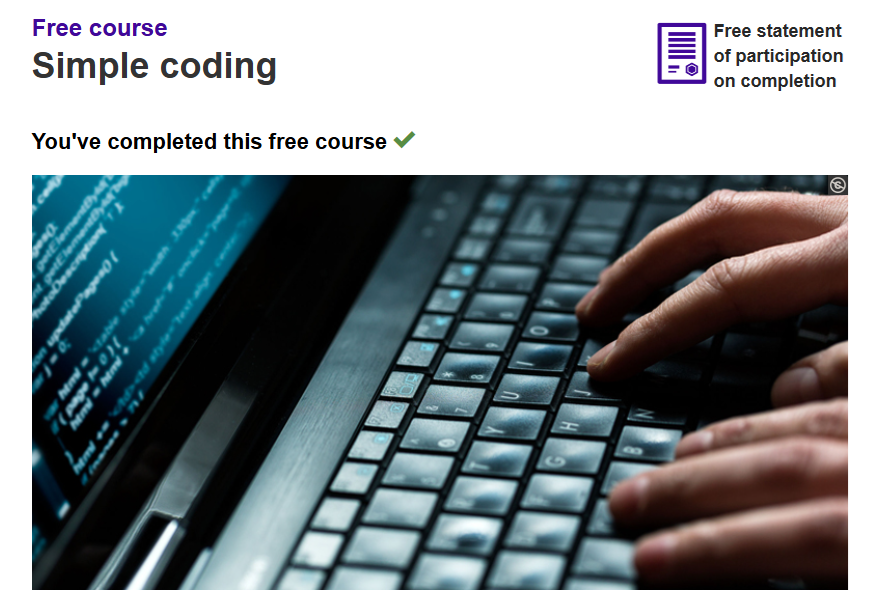
Have you ever wanted to try out simple coding? Want to understand the basics of what it entails? This course introduces you to the skills, concepts and jargon of coding.
Course Learning Outcomes:
After studying this course, you should be able to: (1) use programming language Python to produce code, (2) understand the sequences of instructions in Python programmes, and (3) understand repetition in Python programming language.
Download this Course: simple_coding_printable
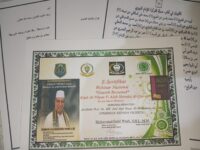
Lihat disini: Statement of Participation: SCOD_1_statement
Tables and charts are a great way to present numerical information in a clear and concise form. This free course, Presenting information, explains how to use the Windows calculator to carry out basic operations and calculate percentages. You will then learn how to use charts and tables to represent and interpret information.
Course learning outcomes
After studying this course, you should be able to: (1) use the Windows calculator to carry out basic operations and calculate percentages, (2) interpret and use information presented in tables and charts, and (3) round numbers appropriately.
Download this Course: presenting_information_printable
Lihat disini: Statement of Participation: T175_7_statement
Free Course: Introducing ICT Systems (9 hours study, Level 1: Introductory)
Information and communication technologies (ICTs) systems now dominate our everyday lives. This free course, Introducing ICT systems, will explain what constitutes such a system and how ICT systems work. You will also look at how ICT systems convey, store and manipulate data, and how they process data. Finally you will learn how these systems are used.
Course learning outcomes
After studying this course, you should be able to: (1) understand the meaning of all the terms highlighted in the text, (2) demonstrate an awareness of the main processes in an ICT system (sending, receiving, storing, retrieving, manipulating, conveying), (3) demonstrate an awareness of some of the hardware, software and communication components used in ICT systems, (4) use a system map or a block diagram to identify the components of an ICT system, and (5) use the units for conveying data and those for storing data appropriately, including use of the prefixes kilo, mega and giga.
Download this Course: introducing_ict_systems
Lihat disini: Statement of Participation: T175_3_statement
Demikian sedikit catatan dari penulis sebagai pengingat kegiatan yang telah diikuti. Insya Allah, pada kesempatan lain, penulis akan mengulas konten daripada ketiga Free Courses “Digital & Computing” OpenLearn the Open University tersebut diatas. Semoga bermanfaat adanya. Barakallahu fiikum. (*)