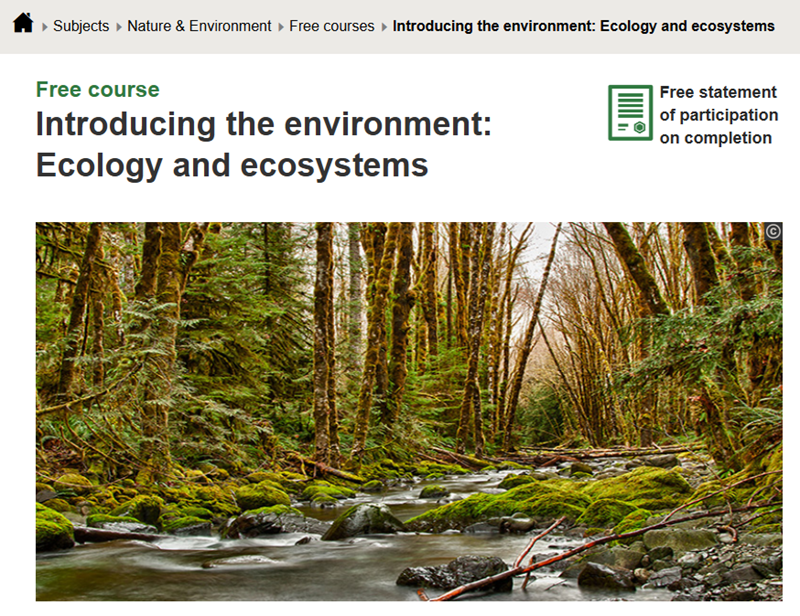
What is ecology and why is it important to our understanding of the world around us? This free course, Introducing the environment: Ecology and ecosystems, looks at how we can study ecosystems to explore the effect that humans are having on the environment.
Course learning outcomes:
After studying this course, you should be able to: (1) construct a glossary of scientific terms, and (2) make notes on what has been read and review these notes. (Download this course: introducing the environment_ecology and ecosystems_printable)
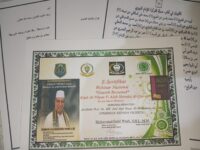
Lihat disini: Statement of Participation: Y181_1_statement
Mammals come in a bewildering variety of shapes and sizes, and yet all species have some characteristics in common. These similarities justify the inclusion of all such diverse types within the single taxonomic group (or class) called the Mammalia. This free course, Introducing mammals, offers a starting point for the study of mammals. It will establish their rich diversity, while highlighting the common features that define the group.
Course learning outcomes
After studying this course, you should be able to: (1) explain the distinctive biological features of monotremes, (2) distinguish contrasting modes of reproduction in monotremes, marsupials and placental mammals, (3) describe the cellular basis of lactation and explain the benefits of an early diet of milk, (4) explain the significance of mammalian metabolic rate, and (5) explain how and why the thermogenic response differs among species. (Download this course: introducing mammals_printable)
Lihat disini: Statement of Participation: s182_12M_statement
Microbes often get a bad name. Whilst some of them do cause disease, others play vital roles in recycling nutrients in the soil to enable plants to grow, and in breaking down human waste. Without microbes, we would have no beer, no yoghurt, no coffee. That’s quite impressive for something too small to see. This free course, Microbes friend or foe? sheds some light on them.
Course learning outcomes
After studying this course, you should be able to: (1) demonstrate general knowledge and understanding of some of the basic facts, language, concepts and principles relating to microbiology and its importance and applications in biological and health sciences and environmental sciences, (2) understand the contribution that microbiology can make to informed debate on medical and environmental issues, and (3) make sense of information presented in different ways, including textual, numerical and graphical material. (Download this course: microbes_friend or foe_printable)
Lihat disini: Statement of Participation: SG071_1_statement
Demikian sedikit catatan dari penulis sebagai pengingat kegiatan yang telah diikuti. Insya Allah, pada kesempatan lain, penulis akan mengulas konten daripada ketiga Free Courses “Nature & Environment” OpenLearn the Open University tersebut diatas. Semoga bermanfaat adanya. Barakallahu fiikum. (*)