In this free course, Evolution through natural selection, we describe the theory of evolution by natural selection as proposed by Charles Darwin in his book, first published in 1859, On the Origin of Species by Means of Natural Selection, or The Preservation of Favoured Races in the Struggle for Life. We will look at natural selection as Darwin did, taking inheritance for granted, but ignoring the mechanisms underlying it.
Course learning outcomes:
After studying this course, you should be able to: (1) understand that by biological evolution we mean that many of the organisms that inhabit the Earth today are different from those that inhabited it in the past, (2) understand that natural selection is one of several processes that can bring about evolution, although it can also promote stability rather than change, (3) understand that the four propositions underlying Darwin’s theory of evolution through natural selection are: (a) more individuals are produced than can survive; (b) there is therefore a struggle for existence; (c) individuals within a species show variation; and (d) offspring tend to inherit their parents’ characters, (4) understand that the three necessary and sufficient conditions for natural selection to occur are: (a) a struggle for existence; (b) variation; and (c) inheritance, and (5) understand that Endler’s experiment with guppies demonstrated that evolution through natural selection can occur in relatively few generations. Download this Course: evolution_through_natural_selection_printable
Lihat disini: Statement of Participation: S103_1_statement
Coastal environments are by their nature ever-changing. This free course, Managing coastal environments, looks at the example of the Blackwater Estuary in Essex, England, describing how the current state of the estuary came to be. It examines the contests and conflicts that centre on the estuary in terms of managing the environment for human needs and the needs of the other species who make their habitat there.
Course learning outcomes
After studying this course, you should be able to: (1) recognise the interaction of human and physical processes in the making of environments and the understanding of environmental issues, (2) understand coastal regions as dynamic and contested environments, (3) consider the contested nature of coastal management policies using the case study of managed retreat. Download this Course: managing_coastal_environments_printable
Lihat disini: Statement of Participation: U216_1_statement
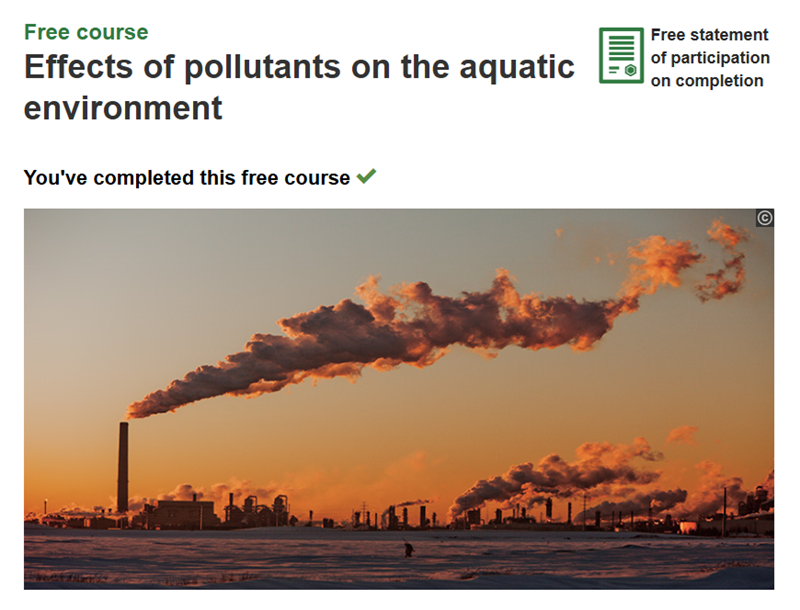
Effects of pollutants on the aquatic environment is a free course. It begins with an introduction to water and goes on to briefly outline the major sources of water pollution (these being sewage works, manufacturing and industrial plants, the farming and animal husbandry sectors, landfill sites and urban surface water run-off). It considers the major water pollutants and describes the effects they have on water.
Course learning outcomes
After studying this course, you should be able to: (1) list the major sources of water pollutants, (2) describe the effects on water due to organic materials, plant nutrients and toxic, physical and biological pollutants, and (3) list the main diseases caused by microorganisms that can be carried by water.
Download this Course: effects_of_pollutants_on_the_aquatic_environment_printable
Lihat disini: Statement of Participation: T868_1_statement
Please note that this is not a course containing teaching materials. It collates links to a variety of courses and other resources about natural selection, its relevance to different environments and animal species, and the theory’s influence on future scientists, psychologists and philosophers. It will be of interest to anyone wishing to study Darwin’s theory of evolution and natural selection and how his work has gone on to influence other work around this theory.
Course learning outcomes
After studying this course, you should be able to: (1) understand Darwin’s theory of evolution and natural selection, (2) recognise how his theory has influenced other work in this area and beyond.
Download this Course: studying_darwin_printable
Lihat disini: Statement of Participation: Darwin_1_statement
There is a fascinating world of nature all around us which we can see if we know how to look for it. Wherever you live, be it in a city or the countryside, you will find areas that support a range of wildlife. This free course, Neighbourhood nature, will provide you with basic scientific and observational skills so that you can go into your local neighbourhood to discover the animals and plants in open spaces. You will learn how to observe, identify and record the wildlife around you, building up a picture of a small part of your local environment.
Course learning outcomes
After studying this course, you should be able to: (1) understand how woodland is structured, (2) understand what is meant by the term ‘ancient woodland’ and how such woodland may be recognised, (3) understand how certain woodland management methods can benefit biodiversity, and (4) understand the conservation importance of ancient trees.
Download this Course: neighbourhood_nature_printable
Lihat disini: Statement of Participation: S159_1_statement
After studying this course, you should be able to: (1) understand the difference between energy and power, and their units and prefixes, (2) state the relative contributions of different natural energy sources to the global energy budget, (3) describe the contribution of photosynthesis to the carbon cycle, and distinguish the terrestrial and marine parts of the cycle, (3) discuss the issues involved in concentrating, storing and transporting energy, and (4) recognise which energy resources have a low energy density, and which have a high energy density.
Download this Course: energy_resources__an_introduction_to_energy_resources_printable
Lihat disini: Statement of Participation: S278_2_statement
Demikian sedikit catatan dari penulis sebagai pengingat kegiatan yang telah diikuti. Insya Allah, pada kesempatan lain, penulis akan mengulas konten daripada ketiga Free Courses “Nature & Environment” OpenLearn the Open University tersebut diatas. Semoga bermanfaat adanya. Barakallahu fiikum. (*)