Oleh: Muhammad Farid Wajdi *)
Related Post: Statement of Participation: Getting Started With Chinese (1-2-3)
BLOGGURU – Alhamdulillah, satu kesyukuran dan kebahagiaan tersendiri dapat mereguk nikmatnya menuntut ilmu dan pembelajaran tanpa batas. Semuanya ini dapat terwujud atas berkah waktu luang, kesempatan, dan kesehatan yang baik. Hari ini, Selasa (26/8/2025), saat berada di Hotspot Center dalam Lingkungan Ponpes Modern Putri IMMIM Minasatene-Pangkep, disela-sela kegiatan ngeblog dan mengajar, penulis menyempatkan mengikuti 7 Free Courses “Languages” di situs OpenLearn, the Open University yang berpusat di Inggris, dengan kampus utama di Milton Keynes, Buckinghamshire, Inggris (United Kingdom).
Ketujuh Kursus pada Menu “Languages” OpenLearn The Open University ini sudah lama penulis akrabi materi dan sebenarnya merupakan pengulangan (muraja’ah) materi pembelajaran tentang Ragam Bahasa di Dunia. Ketujuh Kursus yang penulis ikuti ini bersifat Free (gratis) di situs OpenLearn, termasuk sertifikat tanda penyelesaian kursus yang disebut “Statement of Participation”.
Keenam Kursus singkat (4-8 JP) yang penulis ikuti langsung diselesaikan pada hari ini, Selasa (26/8/2025) adalah sebagai berikut (lengkap dengan deskripsi dan outcome dalam Bahasa Inggris):
1. Free course: Why study languages? (5 hours study, Level 1: Introductory)
Course learning outcomes:
After studying this course, you should be able to: (1) give examples of how language is related to culture in local, national and global contexts, (2) describe some traditions related to different cultures, using words from the relevant languages, (3) explain the importance of learning languages and being aware of cultural differences, (4) develop strategies for improving foreign language writing and speaking skills, and (5) identify the opportunities for studying languages at school and post-compulsory education.
Download this course: why_study_languages__printable
Lihat disini: Statement of Participation: LANGSTU_2_statement
2. Free course: Form and uses of language (4 hours study, Level 1: Introductory)
In this free course, Form and uses of language, we will consider how language can be used in different ways for different purposes. To do this we will use the theme of memorial and commemoration. In the first section we briefly discuss the life of the poet Siegfried Sassoon before examining both his poetry and his prose. Through this we will see how Sassoon conveys meaning in different ways for different audiences using different forms. Following this we discuss more generally how different meanings can be conveyed using prose and poetic language.
Course learning outcomes:
After studying this course, you should be able to: (1) understand how language can be used for different purposes, and (2) understand the importance of form and word choice when addressing different audiences.
Download this Course: form_and_uses_of_language_printable
Lihat disini: Statement of Participation: A103_5_statement
3. Free course: English in the world today (8 hours study, Level 1: Introductory)
How did English become the global force it is today? This free course, English in the world today, explores the status of the language and its worldwide diversity. It looks at how social and political factors influence people’s attitudes towards it, and at the relationship between one’s linguistic heritage and sense of identity.
Course learning outcomes
After studying this course, you should be able to: (1) understand the diversity of English through history and around the world, (2) understand the effect of social and cultural factors on an individual’s use of English, (3) understand the relationship between a person’s linguistic heritage and their sense of identity, and (4) understand the ways in which different varieties of English in use around the world are categorised.
Download this Course: english_in_the_world_today_printable
Lihat disini: Statement of Participation: U214_1_statement
4. Free course: Language and creativity (8 hours study, Level 2: Intermediate)
This free course is an introduction to the relationship between language and creativity, to the roles that linguistic creativity plays in culture and society, and to the different approaches to its study.
Course learning outcomes:
After studying this course, you should be able to: (1) understand key issues in the relationship between language and creativity, (2) understand some of the different ways that linguistic creativity can be studied, (3) understand the importance of creativity in human communication.
Download this course: language_and_creativity_printable
Lihat disini: Statement of Participation: E302_1_statement
5. Free course: How to be a critical reader (7 hours study, Level 2: Intermediate)
In this free course you will focus on how to be a critical reader. Reading critically is an essential skill at university. It means being aware of your own purposes and opinions as you read and being able to recognise the writer’s purposes and opinions in their writing.
Course learning outcomes:
After studying this course, you should be able to: (1) consider the importance of examining attitudes to texts, (2) understand the organisation of argument texts, (3) distinguish between facts and opinions in texts, (4) examine hedging as a technique used by writers to express opinions and avoid making unsupported generalisations, (5) consider the importance of reliable evidence to support claims.
Download this Course: how_to_be_a_critical_reader_printable
Lihat disini: Statement of Participation: L185_1_statement
6. Free course: Cultures (5 hours study, Level 2: Intermediate)
In this free course, Cultures, you will address the question of traditional music and music from the francophone world, and you will examine the place they occupy in the world of artistic creation. The course is divided into three sections: ‘Is traditional music, current music?’, ‘The musical heritage of Normandy’ and ‘Music of the francophone world’.
Course learning outcomes
After studying this course, you should be able to: (1) understand the progression in the comparison, (2) understand the infinitive as subject of a sentence, (3) understand the vocabulary of song, (4) understand the tradition of oral culture, and (5) understand how to write an introduction and a conclusion.
Download this course: cultures_printable
Lihat disini: Statement of Participation: L211_1_statement
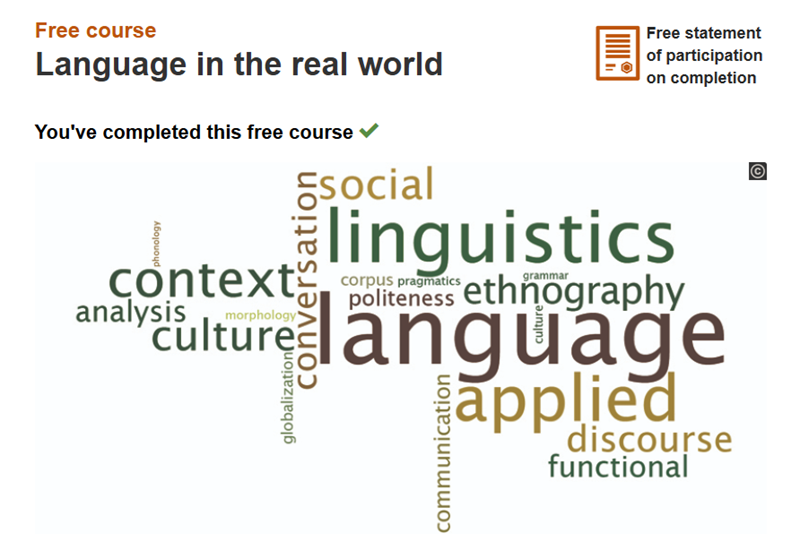
7. Free course: Language in the real world (6 hours study, Level 3: Advanced)
This free course, Language in the real world, explains and illustrates why a knowledge about how language works (i.e. ‘linguistics’) is helpful – some might say essential – for different aspects of our everyday lives. It provides an introduction to ideas around what language is and to the field of Applied Linguistics, which is dedicated to exploring and addressing situations where language plays a crucial role.
Course learning outcomes:
After studying this course, you should be able to: (1) understand and describe the key features of (human) language and languages, (2) understand what applied linguistics is, and (3) explore different contexts where language is a central issue.
Download this course: language_in_the_real_world_printable
Lihat disini: Statement of Participation: EE817_1_statement
Demikian sedikit catatan dari penulis sebagai pengingat kegiatan yang telah diikuti. Insya Allah, pada kesempatan lain, penulis akan mengulas konten daripada ketujuh kursus “Languages” tersebut diatas. Semoga bermanfaat adanya. Barakallahu fiikum. (*)
Minasatene-Pangkep, 26 Agustus 2025
(* Muhammad Farid Wajdi, Guru/Pengasuh Ponpes Modern Putri IMMIM Minasatene-Pangkep, Sulsel.